How Stories Can Help Us Face Climate Change
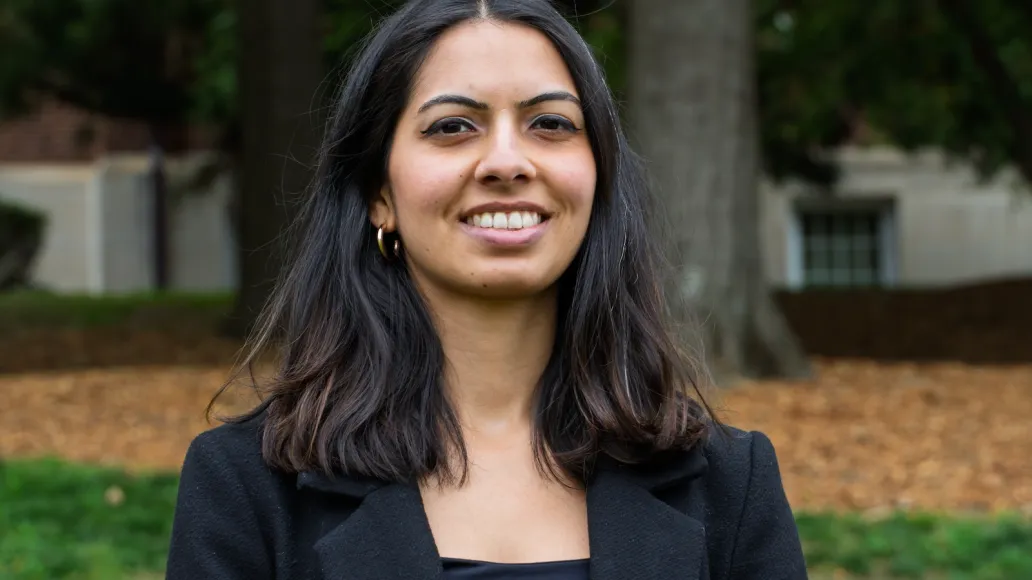
By Jessica Weiss ’05
When Rashi Maheshwari arrived at the University of Maryland from Delhi, India, one of the first things she noticed was the air.
After years in one of the world’s most polluted megacities, her ability to breathe clean air felt startling. The contrast prompted deeper questions: Why do some communities bear heavier environmental burdens than others? Who has access to clean air and water, who doesn’t and why?
Those questions eventually reshaped Maheshwari’s research in UMD’s Department of English. Now a third-year doctoral student in comparative literature, she studies climate fiction, environmental humanities and the power of storytelling to help people understand a changing climate. She has also completed two levels of UMD’s Teaching Sustainability certificate to strengthen her understanding of the scientific foundations behind the issues she studies.
This semester, she is teaching a comparative literature course called “Global Literature and Social Change: Storying the Anthropocene,” exploring how stories shape the way people imagine the planet, crisis and possibility. She is also a 2025-26 Arts for All fellow.
This Earth Month, we spoke with Maheshwari about why the humanities are a vital force in responding to environmental and social challenges.
Stories and novels were one of your first entryways into this field. Why are stories so important in conversations about climate change?
We always think of climate change as something distant from us and something in the future—rising temperatures, shrinking ice caps, policy goals, carbon parts per million. These descriptions can feel very abstract. But art can make that experience very personal and palpable. It creates a certain kind of emotion and affect in the way a scientific document or policy document often cannot. I read a lot of climate fiction novels, and I became really interested in how they interweave scientific concepts and climate change into different narratives—how it is affecting people, displacing communities, eroding ecosystems, and chipping away at lives in ways that remain invisible to traditional forms of reporting. Storytelling helps us grapple with the complexities of climate change, while also amplifying voices that are too often sidelined in scientific discourse.
Your research now spans literature, documentaries, visual art and more. What drew you toward a more multimodal approach?
As my research expanded, I started paying a lot more attention to other mediums beyond novels. In the course I’m teaching right now, we’ve studied graphic novels like Joe Sacco’s “Paying the Land” and Thi Bui’s “The Best We Could Do,” watched documentaries including “All That Breathes” and “The Elephant Whisperers,” and read essays such as Jamaica Kincaid’s “A Small Place” and Robin Wall Kimmerer’s “The Serviceberry.” I’m interested in the way all these narratives—short stories, novels, comics, visual art, poetry, essays—can expand our imaginative capacities to understand climate change.
Your dissertation asks a big question: What can the humanities do for climate change?
Yes, I’m focusing on global Anglophone literature and looking at novels and art from around the world. Novels are often centered around individual heroes who face challenges, overcome obstacles and emerge stronger. But take a novel like “The Overstory” by Richard Powers; at the center of his novel are trees. You hardly ever pick up a novel that is about trees. Powers challenges the anthropocentrism that we often carry through life. A lot of the literature I’m examining does similar things. It challenges our conception of what we know—and what we can know—about climate change through the humanities. It also challenges what we think a novel itself should be.
You’ve said, “Dystopia is here. Dystopia is now.” What do you mean by that?
A lot of the works I read are science fiction, and there is a lot of literature about dystopian futures. But I spend more time thinking about the present because there’s a way in which we defer responsibility and action when we are only talking about the future. For many people, especially marginalized communities and communities in the Global South, environmental catastrophe is now, not in the distant future. Flooding, pollution, displacement and environmental racism are already part of daily life. We often don’t think about how immediate the consequences are because we don’t necessarily face the brunt of a changing climate directly.
You’ve also created hands-on public projects, including through your Arts for All fellowship. Why does that matter to you?
I do a lot of work with the intention of building community. The crisis is so much bigger than us, and it is very difficult to deal with it by ourselves. Through my Arts for All fellowship, I created a semester-long project with my students called “Backyard Biodiversity.” Each student chose one nonhuman neighbor from their daily surroundings—a bird, animal, insect, plant or tree that they regularly encounter but may rarely notice—and followed that species throughout the semester. They kept physical journals, taking field notes, making sketches, doing photography, and learning about the science and cultural significance of what they chose. By attending to the often-overlooked ecologies of their own backyards, students learned to see their environments not as passive backdrops but as active texts that demand attention, interpretation and ethical consideration. Additionally, the creative component fostered multimodal literacy, encouraging students to experiment with artistic forms that make their work accessible to wider publics.
We also did a green spaces tour of campus with one of the arborists and staff working in stormwater management. The university infrastructure often becomes a backdrop to our everyday life, so I wanted them to think more about what exists around them and how much work goes into sustaining those spaces. These activities allowed students to understand how the climate crisis is not merely a scientific or environmental issue, but also a cultural and imaginative one.
What do you hope people take away from your work?
I hope people see that storytelling helps us understand climate change and serves as a powerful tool of resistance. Art can bring people together, shape collective consciousness, amplify marginalized voices and foster a sense of community that can push us into taking action. Art not only documents the loss and resilience of communities but also cultivates solidarity and activism. My research examines how storytelling frames the environmental crisis and how it can inspire engagement with the world around us.
Photo by Jack (Thomas) Brittan-Powell