Arts for All Welcomes 2026–27 Artists in Residence
By Jessica Weiss ’05
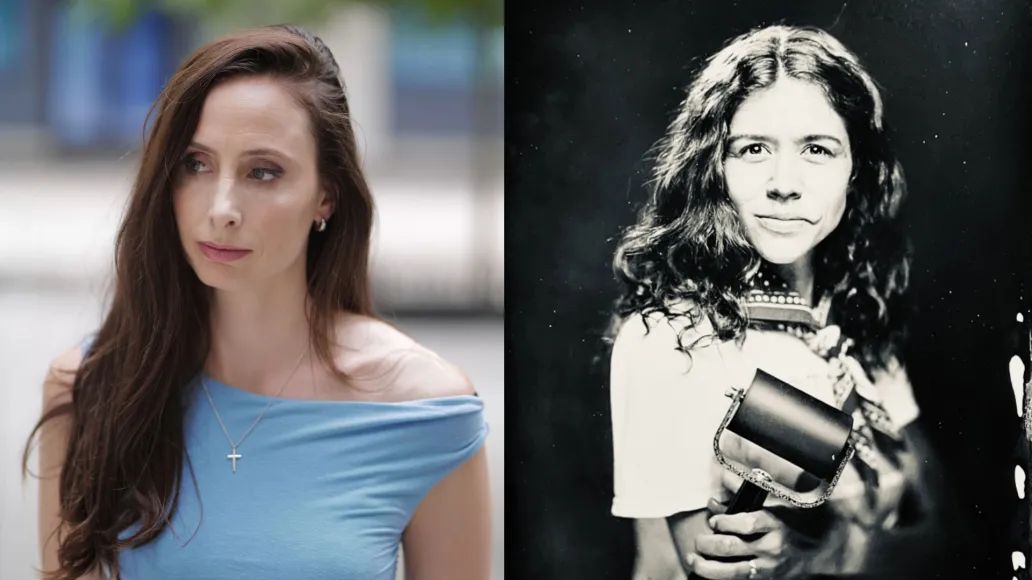
Artists Kate Eberstadt and Kayla Clark will join the University of Maryland as Arts for All’s 2026–27 artists in residence, exploring the connections between the arts and other disciplines. Eberstadt will invite students to create original artworks inspired by quantum physics, while Clark will bring 120-year-old printing presses to the heart of the Philip Merrill College of Journalism.
The Arts for All Artist in Residence program invites working artists to campus for semesterlong residencies designed to foster collaboration across disciplines and explore contemporary issues through the arts. Each artist develops a course open to students across majors, pursues arts-based research and leads public events that engage the broader campus community.
“We’re excited to welcome Kate and Kayla to UMD and for our students to take part in these classes that integrate the arts into two very different disciplines,” said Craig Kier, executive director of Arts for All and professor in the School of Music. “These residencies beautifully embody a core aspect of Arts for All: creating opportunities for students and the broader community to discover how the arts can open up new ways of approaching complex ideas.”
Learn more about this year’s artists:
Kate Eberstadt
In residence this fall, New York-based artist, composer, writer and theater-maker Kate Eberstadt is partnering with UMD’s Joint Quantum Institute and the Department of Physics to explore the creative possibilities of quantum physics.
Eberstadt’s artistic practice spans music, theater, writing and multimedia performance, often exploring questions of human connection. Inspired by her work as a teaching artist in communities affected by displacement, she began grappling with what it means to remain connected to people separated by time and distance—questions that eventually led her to quantum physics. Those ideas now animate her autobiographical solo show “Where We Meet,” which combines music, storytelling and quantum concepts to explore the “hidden forces” that connect people.
She describes the central question of the show as, “Can we use music to connect with people that we're separated from in space and time?”
At UMD, Eberstadt is teaching “Quantum Physics and Art,” an interdisciplinary course that introduces students to quantum concepts—wave-particle duality, superposition, entanglement—and asks them to translate those ideas into original creative work. Students will collaborate with researchers at the Joint Quantum Institute, explore how quantum concepts have inspired literature, music, film and visual art, and develop projects in any medium of their choosing, ranging from paintings and music to performances and film. The semester will culminate in a public presentation of their work.
Eberstadt will also lead public events during her residency, including a presentation of excerpts from “Where We Meet” followed by a conversation with a UMD physicist. Her residency coincides with the show’s development Off-Broadway.
“As an artist, and a person, I believe in the ability of art to connect people of varying backgrounds—no experience necessary,” she said.
Kayla Clark
In Spring 2027, artist, designer and educator Kayla Clark will transform the lobby of Knight Hall into a working print shop, installing two 120-year-old letterpresses and inviting students and the broader campus community to explore the possibilities of analog storytelling.
Clark, a faculty member in the University of Wyoming’s Communication and Journalism Department and Haub School of Environment and Natural Resources, specializes in letterpress printing, participatory design and community-engaged art. Her work reimagines the printing press—once a primary technology for mass communication—as a tool for collective artmaking and dialogue. She was recently selected to represent Wyoming in the National Museum of Women in the Arts’ 2026–27 Women to Watch exhibition program and will have two works exhibited at the museum in Washington, D.C., this spring.
At UMD, Clark will teach “Analog Media Lab: Journalism, Print, and Public Practice,” where students will use historic printing techniques alongside contemporary tools to transform reporting and community stories into zines, broadsides, experimental one-sheet publications and other physical forms. For Clark, slowing down the process offers students a chance to think differently about how journalism can capture attention in an increasingly crowded media landscape.
“We get information from so many different places, and none of it really stands out because there’s just so much of it,” Clark said. “How do we make people care about the small things again when they just get lost in the noise?”
Beyond the classroom, Clark plans to open the Knight Hall print shop to the campus community through drop-in sessions and public workshops where participants can use the historic presses to create prints responding to current events, civic life and personal experiences.
For Clark, placing the presses in a highly visible public space is an opportunity to make artmaking accessible to people who may not typically see themselves as artists.
“Usually press shops are tucked away—in garages or newspaper backrooms and basements. But I'm really excited that these will be on display and available for people to interact with,” Clark said. “I think it will spark really interesting conversations and open up doors for people to engage with the arts in new ways.”
Image: Photos of Kate Eberstadt and Kayla Clark courtesy of the artists.