Announcing Arts for All’s Fall 2025 ArtsAMP Grants
Learn more about 14 new interdisciplinary student projects.
Arts for All is pleased to announce the newest recipients of ArtsAMP grants, which support a wide range of graduate and undergraduate projects. Combining music and AI, dance and mechanical engineering, visual art with science and more, the fourteen projects embody the interdisciplinarity of an arts-informed university.
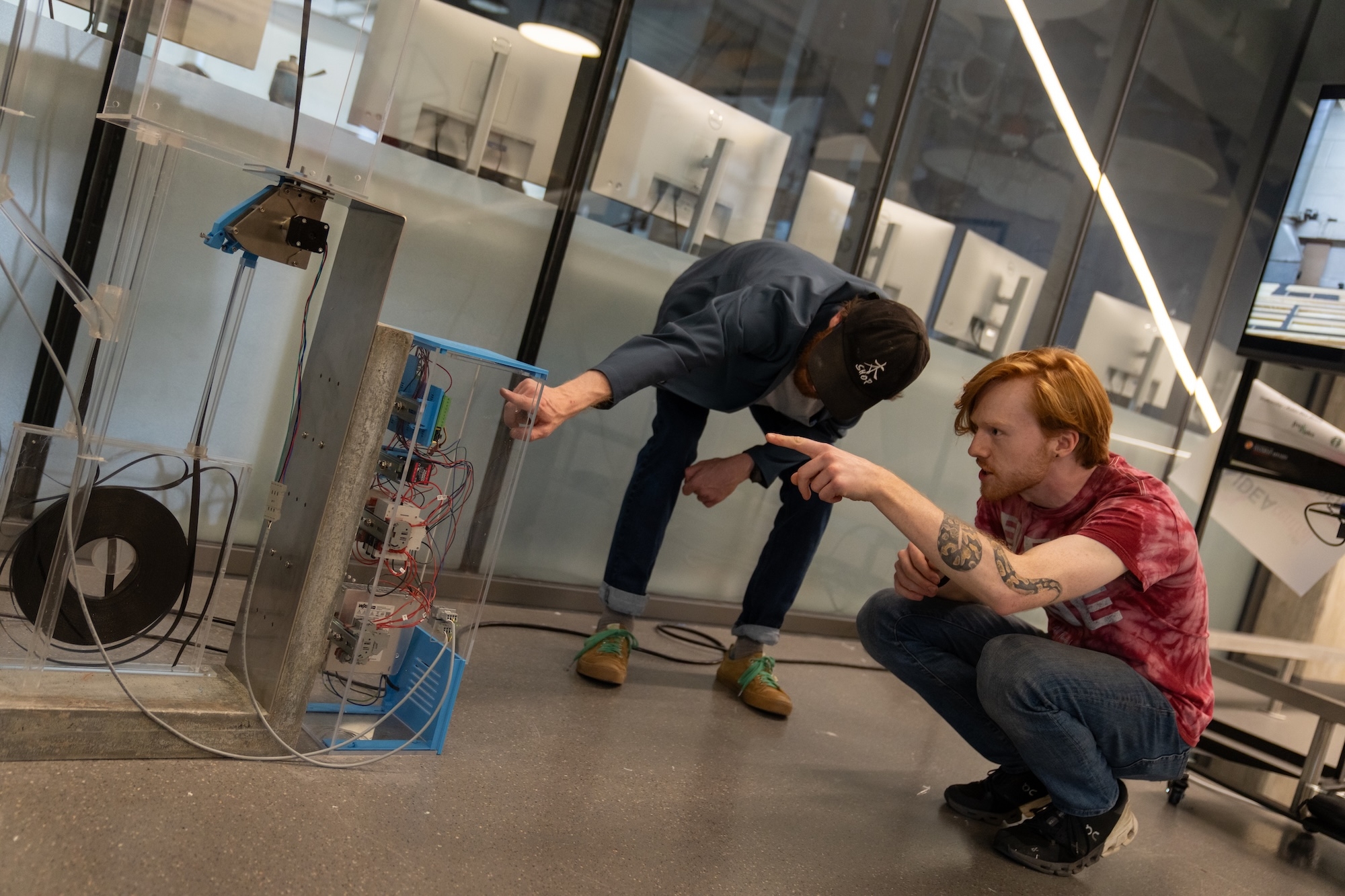
Arts for All is grateful to the Singh Family Sandbox Makerspace for supporting this cycle of grants. As the largest makerspace on campus, this student-run space allows artists, designers and hackers to collaborate and gain hands-on experience with state-of-the-art tools and technology.
Interested in applying? Our Spring 2026 ArtsAMP Grants for students and faculty are now open!
ArtsAMP Collaborative Student MicroGrants
Shue-kei Joanna Mok, a Ph.D. candidate in international education policy, will develop “Earthbound Expressions” in collaboration with the Department of Art and the Department of Environmental Science and Technology. Through a hands-on soil painting workshop and a listening booth with audio recordings and visualizations of soil in different conditions, this interactive installation will invite participants to reflect on ecological land justice and imagine creative sustainability solutions for future generations.
Michael Wang ’26, a computer science major and statistics and data science minor, plans to explore an interdisciplinary approach to live music composition through brain activity in his project “My Brain Knows My Taste.” Using an EEG machine and resources from the Singh Family Sandbox Makerspace, this research will investigate how neural responses correspond to sonic and visual phenomena, transforming brainwave data into real-time generative music and imagery. The resulting immersive experience is a neuro-adaptive experience, generating music that is inherently unique and responsive to the specific brain activity of each individual.
Julie Zalalutdinov ’28, a dance and mechanical engineering double major, will develop “They don’t believe us,” a multidisciplinary dance performance piece exploring the growing uncertainty of truth present in humanity’s interactions with the technological devices used in everyday life. With support from the Singh Family Sandbox Makerspace, she will design and fabricate several mechanical costume pieces that will respond to the dancers’ movements.

Sophie Zhang ’27, an information systems and finance major, received funding on behalf of the Tianyi Dance Team’s annual showcase, a celebration of the rich cultural diversity within Chinese dance. As the University of Maryland’s only Chinese cultural dance team, Tianyi is dedicated to sharing the beauty, history and artistic traditions of China’s many ethnic groups with the campus community. The showcase will highlight a dynamic repertoire that extends far beyond mainstream representations of Chinese dance, featuring styles inspired by Dai, Mongolian, Tibetan, Dunhuang and other cultural and regional traditions.
ArtsAMP Graduate Student Research Grants
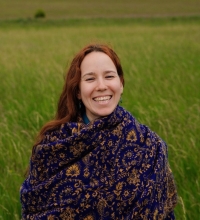
Andzelika Berestko, an M.F.A candidate in art, will create contemplative sculptural spaces utilizing the craft of weaving willow coffins as a way to understand how cultural memory, ritual and ecological knowledge shape relationships to death. By studying an ecologically rooted burial form—renewable, biodegradable and tied to land-based knowledge—she seeks alternatives to industrialized death systems and their spiritual, social and environmental costs.
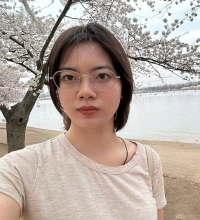
Ruotong Gao, a Ph.D. student in information studies plans to design “Making Time Otherwise,” a participatory installation that centers the lived experience of chronic illness and its fluctuating rhythms shaped by pain cycles, fatigue, medication timing and care routines. Through a series of workshops at the Singh Family Sandbox Makerspace, participants will create pieces of the installation, culminating in a collaborative piece that explores how people experience, negotiate and resist within standardized clock time, and opens possibilities for imagining futures shaped through Crip Time, a concept that addresses the ways that disabled, chronically ill or neurodivergent people experience time differently.
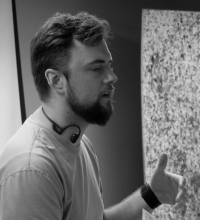
Jeffery Warren Hampshire, an M.F.A candidate in art, will explore how memory is shaped through the shifting and imperfect translations created by digital imaging technology. In “Interpolated Landscapes,” Hampshire will use LiDAR scanning, photogrammetry, photography and video in layered configurations to capture transitional or often overlooked spaces and examine how these digital traces transform when they move from the screen into physical space. This work will be installed in his Spring 2026 thesis exhibition at the University of Maryland Art Gallery.
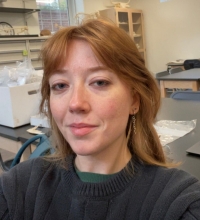
Kristen Hickey, a Ph.D. student in anthropology, will design and produce a series of multidisciplinary collage-based zines using linocut, film photography, sketch and watercolor to amplify zooarcheology research within a creative framework. This work will serve as an experiment in developing a creative methodology that can be incorporated into future archaeological undertakings, public heritage work and community-based approaches to meaning-making.
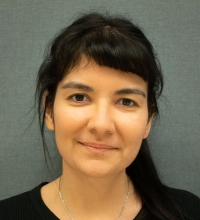
Guzal Isametdinova, a D.M.A candidate in collaborative piano, will explore vocal chamber music as a site of dialogue between Western classical traditions and the musical, poetic, harmonic and sonic worlds of the East. In “Voices Across Culture,” Isametdinova will commission, record and perform new chamber works that represent East–West artistic exchange while examining how sound and text convey cultural identity.
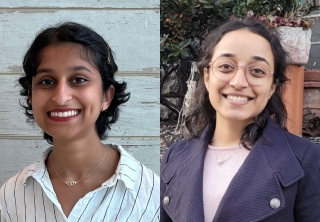
Nitya Jani and Urvi Ashturkar, both M.S. students in human-computer interaction, will research the intersections of technology and creative expression in play therapy. In their study, they will co-design therapeutic digital playrooms with play therapists and children, and use participatory design to investigate whether technology-based play sessions facilitate positive therapeutic outcomes. This study will investigate how technology can be designed to effectively enhance play therapy and empower play therapists with new methods.
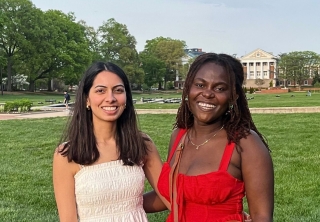
Rashi Maheshwari, a Ph.D. candidate in comparative literature, and Lisa Osei, a Ph.D. student in English literature, will organize “Scents of the Future,” a workshop situated at the intersection of ecocritical theory and Afrofuturist speculation that engages participants in a creative, sensory inquiry: What does the future smell like? By utilizing the olfactory as a speculative tool, the workshop aims to blur the boundaries between art, science and activism—to think with the senses about climate futures, racialized ecologies and possibilities of repair.
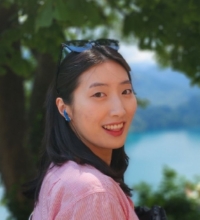
Seyeon Park, a Ph.D. candidate in communication, will conduct a study examining how people attribute agency and experience to AI creators and whether such attributions shape perceptions of authenticity and aesthetic appreciation. The study aims to identify the psychological mechanisms underlying evaluations of AI-generated artwork, assess how creative mindset and emotional openness influence mind and authenticity attributions, and build empirical foundations for understanding audience reception and engagement as critical antecedents to the potential of AI-generated art for narrative persuasion.
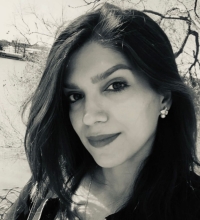
Haniyeh Pasandi, an M.A. student in documentary filmmaking, plans to pilot a new methodology in investigative journalism, blending contemporary dance and immersive visual arts in “The Last Dance,” a groundbreaking new documentary offering the first comprehensive artistic reconstruction of the 2022 Bloody Friday massacre in Iran. This methodology contributes new knowledge to documentary studies by expanding how evidence and testimony in restricted contexts can be understood. By utilizing resources like 3D printing and laser cutting at the Singh Family Sandbox Makerspace and through collaborations with contemporary dancers and choreographers, “Last Dance” becomes both an artistic act of witness and a permanent archive for a community fighting to be seen.
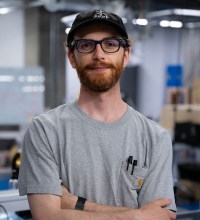
Joshua Prince, an M.F.A candidate in art, aims to build on his current sculptural practice of exploring material properties and their interactions as a source of aesthetic pleasure. In “Assembling Chaos,” he plans to utilize the Singh Family Sandbox Makerspace to continue working across the science, engineering and art disciplines, modifying inputs like the material, energy and form of chaotic systems to create unpredictable and beautiful works of art.