Skip to category
First Place, Visual Art
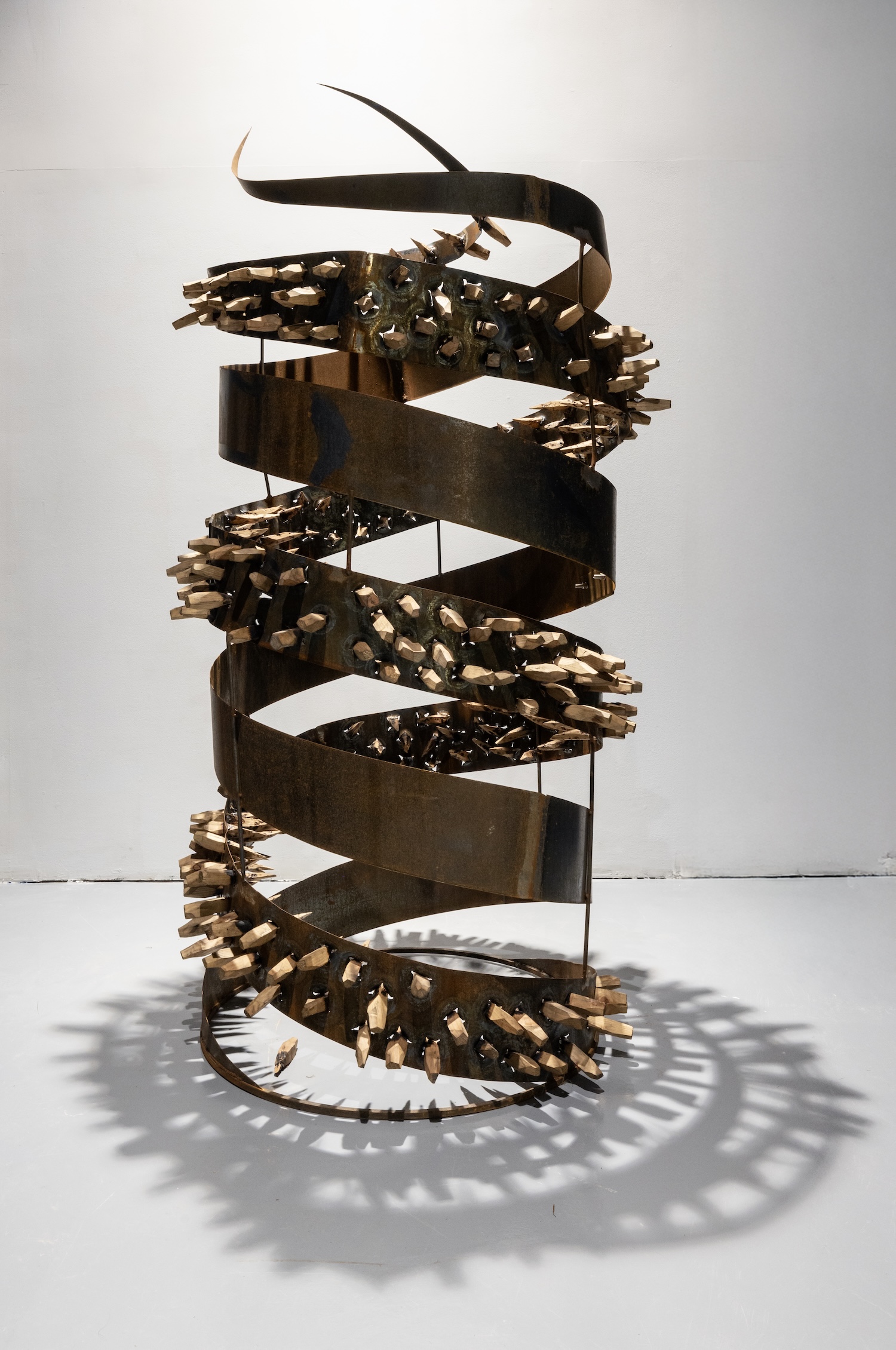
"It’s the American Way" by McCleary Gallagher ’26, studio art; ’25 electrical engineering.
Reading statistics on American gun deaths, immigration enforcement deployments, deportations, and other forms of violence, I struggle to fathom the scale of suffering those numbers conceal. Every datapoint represents a complex human experience as all-encompassing as my own, and yet as numbers on a page, each life teeters on the edge of abstraction - casualties of partisan rhetoric and institutional indifference.
It’s The American Way manifests this tension physically. A large steel helix erupts from the ground, spiraling nearly 9 feet into the air. The industrial material evokes the cold endurance of political institutions, while the sculpture’s form mirrors the self-perpetuating DNA of our nation. One side of the helix is punctured by over 200 jagged wooden forms, each at once invoking a human life lost and a citizen weaponized. This sculpture embodies a corrosive and factional violence turned inwards.
Since our country’s founding, appeals to civic pride and duty have been mobilized to consolidate power, molding citizens into instruments of exclusion and oppression. When the very concept of citizenship is weaponized and made a conditional privilege, the democratic agency it promises rings hollow. If, as Jimmy Carter suggests, the title of citizen is our nation’s highest office, how does it reflect on us when that office is used for harm? How can we interrupt this self-destructive spiral that we’ve inherited?
Second Place, Visual Art

“Between Us” by Sofia Apgar ’26, biological sciences.
This mixed media piece depicts an anonymous pair of hands stitching together pieces of the American flag across two separate canvases, physically connected by a real needle and thread. Only the red and white stripes are included in paint. The blue exists instead as thread: fragile, requiring action, not just a passive symbol. This thread takes the place of the blue in our flag, representing perseverance and justice. Right now, more than anything, it represents responsibility. We, the people, are responsible for the blue.
This work reflects the growing political and social divides in our country. Politicians and media profit when we adopt an us-versus-them mentality, when we are distracted by conflict instead of working together toward real change, toward helping each other, toward sharing knowledge, beliefs, and mutual respect. I chose not to include specific political symbolism because this is not about one side or another. It is about our human nature: how easily we turn against each other, and how difficult it is to mend the painful divides that result.
The responsibility to repair these divides falls on each of us. It is our right and our duty as citizens not only to speak out, but also to listen. There is no progress without compromise. There is no future if we only ever turn to conflict. If we ostracize people for making mistakes, we prevent them from learning, and we prevent ourselves from moving forward together. The stitches are visible because repair does not erase the damage we cause one another, but instead acknowledges it.
The stripes extend off of the canvasses in both directions. This work is slow, difficult, and vulnerable, but we cannot have a whole flag—a whole country—without it. No end is implied. Democracy is not something finished. It is something maintained.
Third Place, Visual Art
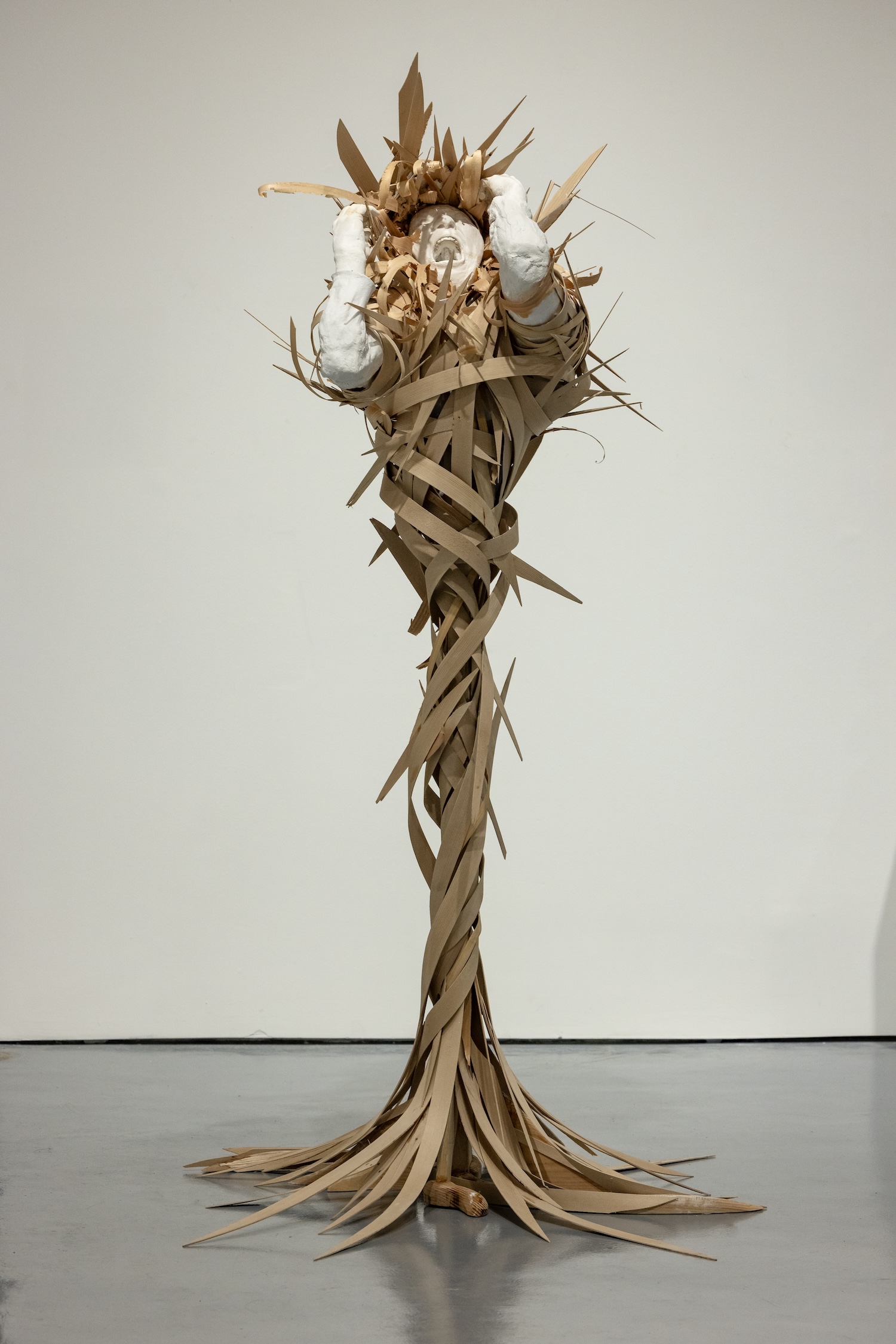
“Silently Screaming" by Christine Nesseth ’26, immersive media design and studio art.
This piece was made in the Spring of 2025 using a wooden armature, an old hoodie, plaster bandages, casting with alginate and plaster, and strips of wood. It was inspired from the feeling of overwhelming frustration and grief over the ethical regressions shown by the government of the United States of America. It represents a scream that needs to come out, but can’t or won’t. It symbolizes the futile feeling of trying to rip out the painful parts of our existence, moments that we endured but never wanted. Often we suppress our expression to assimilate or stay hidden, but the body keeps the score. Awareness and the ebb and flow of encroaching dissonance give way to fear, anxiety, and a sense of claustrophobia. Without expression there is no peace, so sometimes it takes a scream to get it.
Honorable Mention, Visual Art

“Citizen (Abernathy)” by Ava Burke, M.F.A. student.
This piece meditates on two conflicting visions of the American citizen. Citizenship is historically and presently about control. Today, rights conferred by US citizenship are increasingly contingent on compliance with attempts to limit core freedoms of speech, press, and assembly, all demonstrated by events represented in this image that mirror the ongoing siege of US cities by masked gangs of ICE forces. Under such conditions, citizens have the right and duty to embody and enact an alternative vision of citizenship grounded in actions of mutual care and resistance. Artists have the right and duty to document the violence being done in the American name. It is our right and duty to blow the whistle on advancing fascism. It is our right and duty to stand arm in arm with our neighbors.
First Place, Poetry
“Renovated World” by Daniel Parada ’27, information systems and marketing.
Second Place, Poetry
“Rinsed” by Laurine Dzossou-Mawule ’29, undeclared, Jiménez-Porter Writers’ House.
Honorable Mention, Poetry
"Miss Etiquette" by Katie Lynn FitzPatrick ’26, English.
First Place, Music Composition
“Future’s Passed” by John Pablo Rojas, M.M. student in cello performance.
Read artist statement
There was a kind of personal struggle when I began engaging with the quote by former President Carter. There was an initial urge to engage with labor as a concept, as that’s where the idea of citizen’s power comes from in the U.S, but in a sense I also disagree with some of what Carter has to say. Do we really have more power? A failing of his viewpoint arises for me when considering the issue of climate change. While Carter himself established the Department of Energy in an attempt to combat the abusive usage of fossil fuels, that same department is currently headed by a former big oil CEO who believes that there is no climate crisis at all. Inspired by this, my submitted composition is titled future’s passed, which consists of a fixed audio track and a live performance element. The first two pages of score are graphic representations of the fixed audio, which I produced with Clarice Assad during her residency in the fall. Using sampling and multitracking, I aim to highlight how certain politicians ignore consensus from the scientific community and continue to act on behalf of a small minority of people instead of what’s right for our society. The collective voice of science around the world is still not enough to defeat corruption in our government. The final page is an improvised score for open instrumentation (realized by cello quartet in the recording), and it’s meant to engage with the content of the fixed audio. A sampled claim from Secretary Marco Rubio states there are no “actions we can take today that would actually have an impact on our climate.” What makes an action truly impactful? The improvisatory aspects of the score are my meditations on this. One simple change from a performer changes everything in the sonic texture, reminiscent of Carter’s sentiment about the power of the citizen. By juxtaposing the fixed audio with improvisation, I invite performers and listeners to reflect on their collectively important roles as caretakers of this planet.
Honorable Mention, Music Composition
“A House Upon a Hill” by Lily Gallihue ’26, vocal performance and music composition.
Listen to "A House Upon a Hill" View score for "A House Upon a Hill"
Read artist statement
On December 8th, 2016, Former U.S. President Jimmy Carter wrote that "In our democracy, the only title higher and more powerful than that of president is the title of citizen. It is every citizen’s right and duty to help shape the future legacy of our nation." When he penned this WSJ op-ed, he watched a “political transition... fraught with uncertainty.” But times would only grow more uncertain from there.
In 2025, I did not feel higher and more powerful than the title of president. I woke up to countless Executive Orders declaring my existence as a transgender woman as first “woke DEI,” then pedophilia, then a terroristic threat. I did not know what to do. Amidst this internal conflict, I wrote a series of poems, all parts to a future opera called A House Upon a Hill. I crafted a fantasy of an emigrant sailing from a land that no longer loves them, but as I wrote, the guilt grew more powerful. I wrote the piece with new clothes and a full stomach, all while I watched immigrants be stolen from their homes, while federal agents killed protestors. But while all these horrible things were happening, I watched my church deliver food to immigrant parishioners. I watched my tiny rural hometown be taken over by roadside protesters. I watched “people in union,” defining their own fate. And so, as A House Upon a Hill was written, I watched more and more, and my resolve strengthened movement-by-movement.
That growth culminates in my submission – the fourth and final part of A House Upon a Hill. Unlike the rest of the piece, which depicts a continuous narrative set in the present, Part Four is a standalone song about the future. It imagines a better world – a “future legacy of our nation” that we can all pursue. Throughout the work, the singer is unconvinced that this legacy is even possible, not unlike me not long ago. But this final section recognizes the power community actions have in shaping a legacy. The “weight of progress” is heavy, yes, it takes great effort, but as Carter notes, it is our duty. And those weights are easier to lift with others – Carter does not say “some citizens,” or “a citizen.” He says “every.” He calls for everyone to shape their nation, to build that “Shining City Upon a Hill” America was deemed so long ago. A House Upon a Hill is my answer to that call.
First Place, Chamber Music Ensemble
“I dream a world” from Cedric Adderley’s Three Dreams by Addison Littlefield, M.M. student in opera performance, and Hanako Duffie, graduate student in collaborative piano.
Read artists statement
Our piece, “I Dream a World” from Cedric Adderley’s Three Dreams song cycle, imagines what the world could look like if people truly accepted one another. The text comes from an iconic poem by Langston Hughes, which has been set to music by many composers and is a foundational example of American poetry. Known as one of the leaders of the Harlem Renaissance, Hughes wrote with a deeply personal sense of yearning for a better and more respectful world. Cedric Adderley, who is a living POC composer, conductor, and educator has set the text in a unique and introspective way. His musical interpretation highlights the quiet hope and reflection within the poem. The music allows listeners to imagine a future where love, peace, freedom, acceptance, and joy are central parts of citizens’ lives, without race dividing them. Former president Jimmy Carter stated that the most powerful title in a democracy is that of citizen and that it is the responsibility of every person to help shape the nation’s future. “I Dream a World” reflects this idea by reminding us that the work of creating a just and accepting society is not finished. Instead, the piece expresses hope that citizens can work together to build a better future. The longing for a more accepting community is one of the main themes in “I Dream a World.” Both the poem and the musical setting remain strikingly relevant today, as marginalized groups in the United States continue to face challenges. By imagining a world without division, the piece encourages citizens to take responsibility for shaping a society built on equality, respect, and shared humanity.
First Place, Film
“Today’s Hair” by Jack (Thomas) Brittan-Powell, graduate student in documentary filmmaking.
Second Place, Film
“Smoke Break” by Mason Vosmek ‘29, cinema and media studies.
Honorable Mention, Film
“The Title of Citizen” by Haniyeh Pasandi, M.A. student in documentary filmmaking.